Annea Lockwood
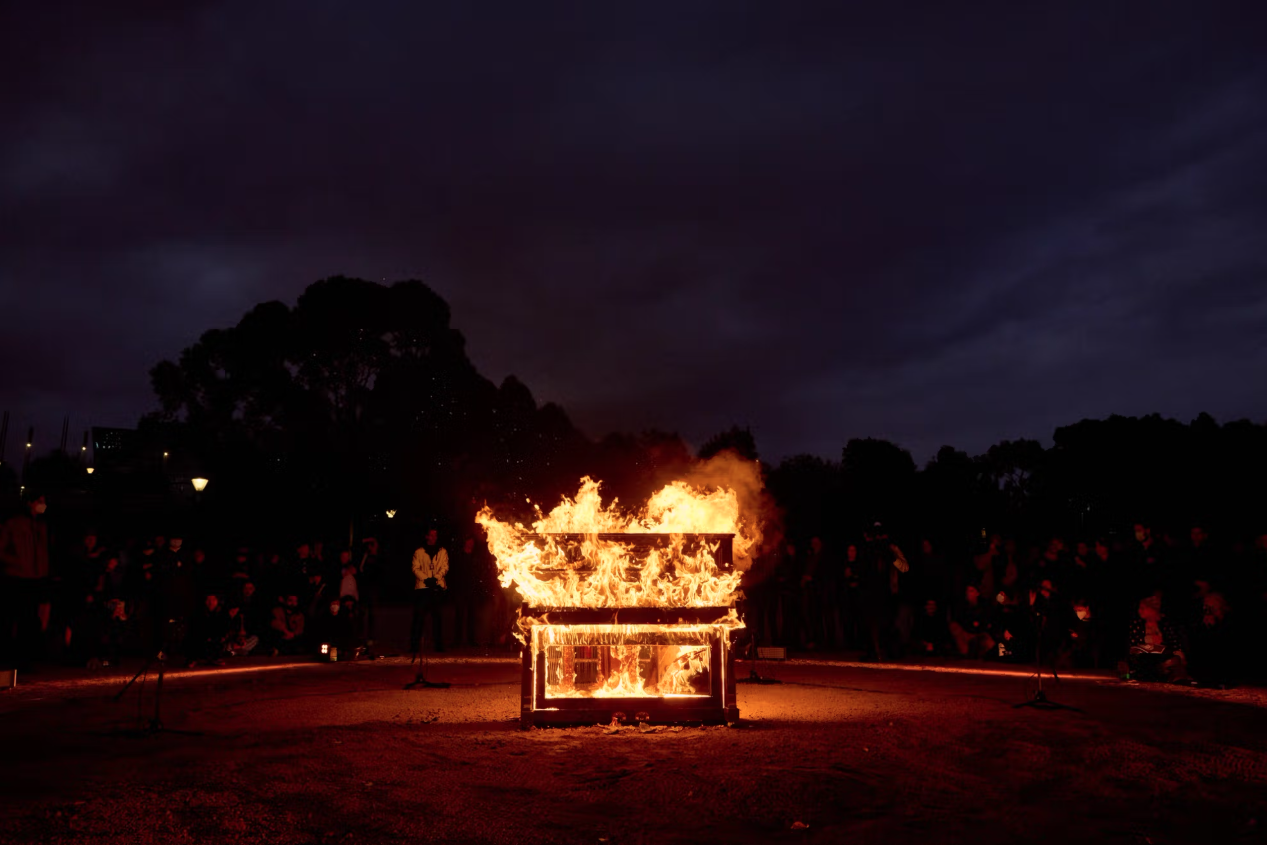
Set upright piano (not a grand) in an open space with the lid closed.
Spill a little lighter fluid on a twist of paper and place inside, near the pedals.
Light it.
Balloons may be stapled to the piano.
Play whatever pleases you for as long as you can.
––––––
Performed by “the queen of the toy piano” Margaret Leng Tan (The New York Times).
Welcome to The Dark.
Annea Lockwood (b. 1939 in Aotearoa, New Zealand) is known for her explorations of natural acoustic sounds and environments in works ranging from installations to concert music. In recent years, her music has received widespread attention, including a Columbia University Miller Theatre Composer Portrait concert, two feature articles in The New York Times, and a documentary film by director Sam Green. Her sound maps of the Hudson River, the Danube, and the Housatonic River have been widely presented in Europe, the U.K., the United States and Australia, in addition to her instrumental works. Three recent collaborative works – Into the Vanishing Point with new music quartet Yarn/Wire, Becoming Air with avant-garde trumpeter Nate Wooley, and Skin Resonance with percussionist-composer Vanessa Tomlinson – were released on Black Truffle Records. Hearing Studies, co-authored with Ruth Anderson, was published by Open Space in 2021.
Wild Energy, a collaboration with Bob Bielecki focused on atmospheric, mammalian, and geophysical infra and ultrasound, is permanently installed at the Caramoor Center, Katonah. Elwha!, co-composed in 2025 with Claire Chase for flutes and field recordings of the Elwha River, received a commission from the Fromm Music Foundation, and recently premiered at the Kitchen in New York City. Other recent presentations of her work include the Ojai Festival, Big Ears, Other Minds, Queen Elizabeth Hall London, Rainy Days Luxembourg, the Los Angeles Philharmonic Noon to Midnight Festival, Tectonics-Athens, and the Huddersfield Contemporary Music Festival.
Lockwood is a recipient of the 2020 SEAMUS Award and is a member of the American Academy of Arts and Letters.
Margaret Leng Tan has established herself as a major force within the American avant-garde; a highly visible, talented and visionary pianist whose work sidesteps perceived artificial boundaries within the usual concert experience and creates a new level of communication with listeners. Embracing aspects of theater, choreography, performance and even “props” such as the teapot she “plays” in Alvin Lucier’s Nothing is Real, Tan has brought to the avant-garde, a measure of good old-fashioned showmanship tempered with a disciplinary rigor inherited from her mentor John Cage. This has won Tan acceptance far beyond the norm for performers of avant-garde music, as she is regularly featured at international festivals, records often for adventurous labels such as Mode and New Albion and has appeared on American public television, at Lincoln Center and Carnegie Hall.
Born in Singapore, Tan was the first woman to earn a doctorate from Juilliard, but youthful restlessness and a desire to explore the crosscurrents between Asian music and that of the West led her to John Cage. This sparked an active collaboration between Cage and Tan that lasted from 1981 to his death, during which Tan gained recognition as one of the pre-eminent interpreters of Cage’s music, partly through her New Albion recordings, Daughters of the Lonesome Isle and The Perilous Night/Four Walls. She has subsequently recorded Works for Piano 4 and Works for Piano 7 for Mode Records’ Complete John Cage Edition. After Cage’s death in 1992, she was chosen as the featured performer in a tribute to his memory at the 45th Venice Biennale.
Tan takes a lively interest in the musical potential of unconventional and unlikely instruments, and in 1997 her groundbreaking CD, The Art of the Toy Piano on Point Music/Universal Classics elevated the lowly toy piano to the status of a “real” instrument. Tan is certainly the world’s first professional toy piano virtuoso. Since then her curiosity has extended to other toy instruments as well, substantiating her credo “Poor tools require better skills” (Marcel Duchamp). She Herself Alone: The Art of the Toy Piano 2, Ms. Tan’s latest toy instrumental album, has been called “one of this year’s finest treasures of new music” (Downtown Music Gallery).
Tan favors music that confronts and defies the established boundaries of the piano and her toy instruments and has collaborated with like-minded composers to create works for her, such as Somei Satoh, Tan Dun, Michael Nyman, Julia Wolfe, Toby Twining and Ge Gan-ru; she is also a favorite of composer George Crumb. Tan’s authority on matters of Cage has evolved from that of an expert interpreter to responsible scholar protecting the textual integrity of his work; Tan edited the fourth volume of Cage’s piano music for C. F. Peters and in 2006 gave the premiere of his newly discovered 1944 work Chess Pieces, which she also edited for publication. Tan’s Mode DVD of Cage’s Sonatas and Interludes includes a video in which she examines the original, 1940s era preparation materials for the work. Photogenic and comfortable with the camera, Tan is the subject of a feature documentary by filmmaker Evans Chan, Sorceress of the New Piano: The Artistry of Margaret Leng Tan, which has been screened at numerous international film festivals including Vancouver, Melbourne and AFI/Discovery Channel’s SILVERDOCS where it was nominated for Best Music Documentary. Sorceress of the New Piano and a bonus film by Chan, The Maverick Piano, is now available on DVD on Mode Records.